Productboard Spark: AI built for PMs. Now available & free to try in public beta.
Try Spark
Productboard Spark: AI built for PMs. Now available & free to try in public beta.
Try SparkProductboard Spark: AI built for PMs. Now available & free to try in public beta.
Try SparkProductboard Spark: AI built for PMs. Now available & free to try in public beta.
Try SparkA product brief is a foundational document that captures the essence of a product opportunity or initiative before teams commit to building solutions. Unlike a PRD (Product Requirements Document) or product spec that details what to build and how to build it, a product brief focuses on the why: the problem worth solving, the users affected, and the business value at stake.
Product briefs serve as the starting point for product discovery, helping teams validate assumptions, explore solutions, and make informed decisions about whether to proceed with an initiative. They're intentionally lightweight and problem-focused, leaving room for iteration and learning before locking into specific requirements.
Creating a product brief before jumping into solutions offers several critical benefits:
Strong product briefs shift how the product organization is perceived. Instead of operating as a cost center that reacts to requests, teams become a strategic driver of business value—grounded in customer insight and deliberate decision-making. By improving the quality of discovery while keeping operational overhead low, product briefs enable teams to learn faster and invest smarter to ultimately deliver outcomes that contribute directly to revenue and growth.
While formats vary by organization, effective product briefs typically include:
1. Problem Statement
A clear, concise description of the user problem or business opportunity. Avoid solution language; focus on the pain point or unmet need.
2. Target Users
Who experiences this problem? Include relevant personas, segments, or customer types with context about their needs and behaviors.
3. Strategic Alignment
How does solving this problem support company objectives, OKRs, or product strategy? Connect the initiative to broader business goals.
4. Current State
What's happening today? Include relevant context about existing workflows, workarounds, or competitive alternatives.
5. Success Criteria
How will you know if you've solved the problem? Define measurable outcomes (not feature completion) that indicate success.
6. Constraints and Assumptions
What limitations exist (technical, timeline, budget)? What assumptions need validation before proceeding?
7. Open Questions
What do you need to learn? List unknowns that require research, analysis, or stakeholder input.
Understanding when to use each document type prevents confusion and wasted effort:
The brief comes first, informing whether to proceed with a PRD. The PRD then guides creation of detailed specs.
Step 1: Start with the problem
Articulate the user pain point or business opportunity in clear, jargon-free language. Use customer quotes or data to ground the problem in reality.
Step 2: Connect to strategy
Link the opportunity to company OKRs, product vision, or strategic initiatives. Make the business case for why this matters now.
Step 3: Define success upfront
Establish how you'll measure whether the problem is solved. Focus on outcomes (user behavior, business metrics) not outputs (features shipped).
Step 4: Identify what you don't know
List assumptions that need validation and questions that require research. This guides your discovery work.
Step 5: Keep it concise
Aim for 1-2 pages maximum. The brief should be scannable and easy to discuss in meetings. Save detailed analysis for supporting documents.
Step 6: Iterate based on learning
Update the brief as you conduct research and gather feedback. It's a living document during the discovery phase.
Initiative Name: [Descriptive name for the opportunity]
Problem Statement: [What problem are we solving? For whom?]
Target Users: [Which personas or segments are affected?]
Strategic Alignment: [How does this support company OKRs or product strategy?]
Current State: [What's happening today? What workarounds exist?]
Success Criteria: [How will we measure success? What outcomes indicate we've solved the problem?]
Constraints: [Technical limitations, timeline, budget, or other restrictions]
Assumptions to Validate: [What do we believe to be true that needs testing?]
Open Questions: [What do we need to learn through research or analysis?]
Next Steps: [What discovery work is needed before deciding to proceed?]
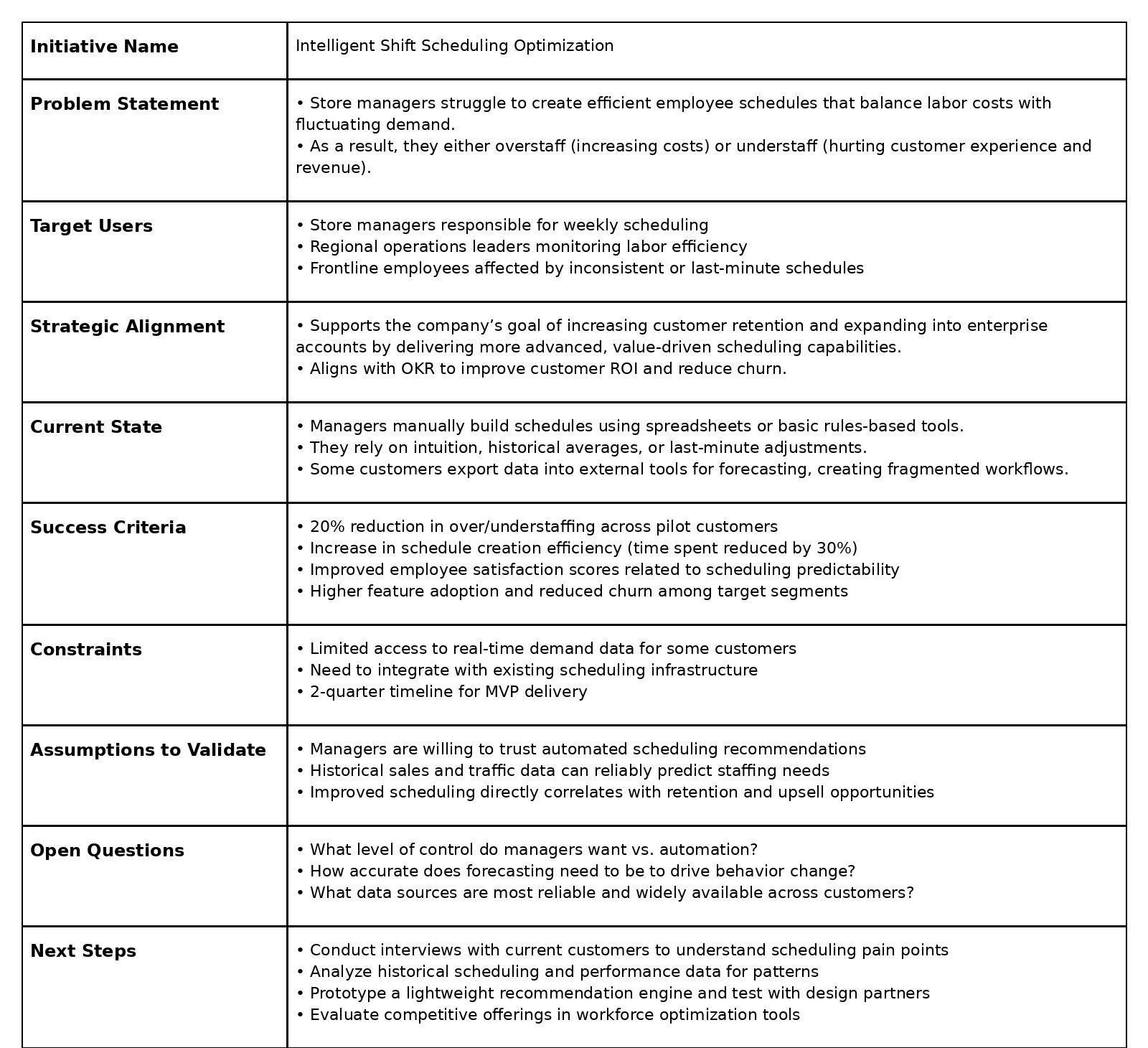
Let’s say you work for a workforce management company that provides scheduling and staffing tools for mid-sized retail and hospitality businesses. This below example helps illustrate how a strong product brief translates abstract best practices into actionable, real-world decision-making tied directly to business outcomes.
How do you know when a problem is “strong enough” to justify a product brief?
A good signal is when the problem shows up repeatedly across multiple sources (e.g., customer reviews, support tickets, sales conversations, usage data). If it’s isolated or anecdotal, it may not warrant a full brief yet. But if it’s persistent, tied to meaningful outcomes (revenue, retention, efficiency), and not easily solved with a quick fix, it’s worth formalizing in a brief.
Product briefs are best suited for opportunities that are ambiguous, high-impact, or strategically significant. Smaller improvements or well-understood requests may not need a full brief. Use judgment—if alignment, validation, or prioritization is unclear, a brief is likely helpful.
Who should own the product brief—and who should contribute?
Product managers typically own the brief, but the best ones are co-created. Engineering can highlight feasibility constraints early. Design can shape problem framing through user empathy. Go-to-market teams can add context from prospects and customers. Treat it as a shared artifact, not a solo document.
Can a product brief cover multiple problems or opportunities?
It’s better to keep each brief focused on a single, coherent problem space. If you find yourself describing multiple unrelated issues, that’s usually a sign you’re bundling too much together. Separate briefs lead to clearer thinking and better prioritization for more effective discovery.