Productboard Spark, AI built for PMs. Now available & free to try in public beta.
Try Spark
Productboard Spark, AI built for PMs. Now available & free to try in public beta.
Try SparkProductboard Spark, AI built for PMs. Now available & free to try in public beta.
Try SparkProductboard Spark, AI built for PMs. Now available & free to try in public beta.
Try SparkProduct teams often confuse PRDs (Product Requirements Documents) and product specs, using the terms interchangeably or creating hybrid documents that serve neither purpose well. While both are essential for successful product development, they serve distinct roles at different stages of the product lifecycle.
Understanding when to use each document, and how they complement each other, helps teams avoid miscommunication, reduce rework, and ship better products faster.
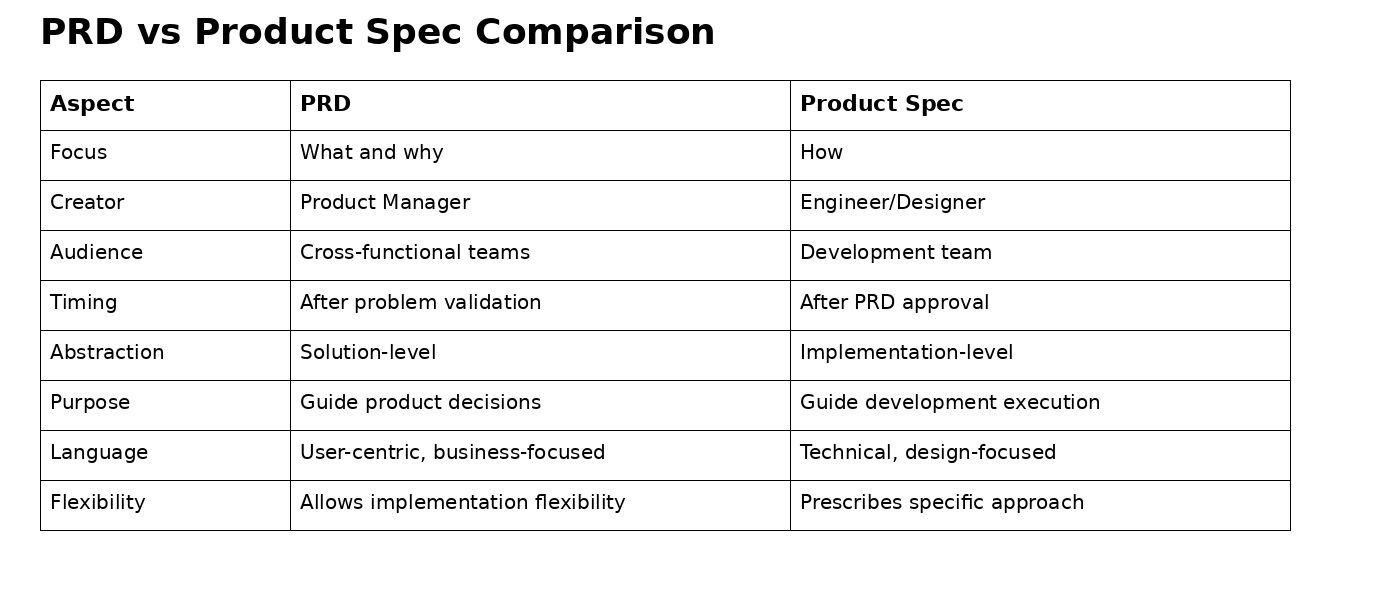
A Product Requirements Document (PRD) is a comprehensive document that defines what you're building and why it matters. Created by product managers, PRDs translate validated problems and opportunities into clear product requirements that guide design and development teams.
A product spec (or technical specification) defines how to build the solution described in the PRD. Created by engineers, designers, or technical leads, specs translate product requirements into detailed implementation plans that guide development work.
A PRD ensures the team is aligned on the problem, user needs, and desired outcomes before work begins, while the product spec translates that direction into a clear, executable plan. Together, they create a shared understanding from strategy through execution, reducing ambiguity, minimizing rework, and helping teams move faster with confidence.
Use both when: You’re building anything where multiple stakeholders are involved (coordination), decisions need to be aligned (clarity), or the implementation carries meaningful complexity (technical depth).
The most effective product development processes use PRDs and specs sequentially:
1. Problem validation (Product Brief)
Define and validate the problem space before committing to solutions. This stage focuses on gathering evidence from customer feedback, market signals, and product data to ensure the problem is urgent and worth solving. The goal is clarity on the opportunity before any requirements or solutions are introduced.
2. Solution definition (PRD)
Product managers translate the product brief into a clear definition of what to build and why it matters. The PRD outlines user needs, success metrics, and functional requirements, creating alignment across stakeholders before development begins. It serves as the source of truth for product intent and decision-making throughout the lifecycle.
3. Technical planning (Product Spec)
Engineering and design teams take the direction from the PRD and define how the solution will be implemented. This includes system architecture, data flows, edge cases, and detailed interaction design. The spec ensures that everyone building the product has a shared, precise understanding of how it should work.
4. Development execution
Teams build according to the product spec, using it as the blueprint for implementation while referencing the PRD to stay grounded in user and business context. As questions or tradeoffs arise, the PRD helps guide decisions back to intended outcomes. This balance keeps execution efficient without losing sight of the original goals.
5. Validation and iteration
After release, teams measure outcomes against the success metrics defined in the PRD to determine whether the solution delivered value. Insights from real-world usage inform updates to both the PRD and the spec as needed. This creates a continuous loop where learning feeds directly into better decisions and future iterations.
Mistake 1: Creating hybrid PRD-specs Mixing product requirements with technical implementation details creates confusion about who owns what and makes both documents harder to maintain.
Mistake 2: Skipping the PRD Jumping straight to specs without clear product requirements leads to building solutions that don't solve the right problems.
Mistake 3: Over-specifying in PRDs Product managers who prescribe technical implementation in PRDs limit engineering creativity and may propose suboptimal solutions.
Mistake 4: Under-specifying in specs Vague technical specs lead to inconsistent implementation, missed edge cases, and rework during development.
Mistake 5: Treating documents as static Both PRDs and specs should evolve as teams learn during development. Update them to reflect decisions and changes.
Not every organization needs formal PRDs and specs for every initiative.
The key is clarity about what you're building (PRD) and how you're building it (spec), regardless of document format.
Streamline your product documentation process with Productboard Spark. Our AI-powered platform helps you create clear, comprehensive PRDs faster by analyzing customer feedback, suggesting requirements, and ensuring strategic alignment. Start your free trial and ship better products with less documentation overhead. See Spark in action.
Do you need both a PRD and a product spec?
In most cases, yes. The PRD ensures teams are aligned on the problem and desired outcomes, while the product spec provides the clarity needed to build the solution correctly. Using both helps avoid rework and improve cross-functional collaboration.
Can a PRD and product spec be combined into one document?
They can be combined in smaller teams or early-stage environments, but this often leads to confusion as products scale. Mixing strategic intent with technical detail can blur ownership and make documents harder to maintain. Separating them helps teams stay focused on either decision-making or execution.
When should you write a PRD in the product development process?
A PRD should be created after the problem has been validated but before development begins. It serves as the foundation for aligning stakeholders and defining what success looks like. Once the PRD is approved, teams can move into creating the product spec and starting implementation.